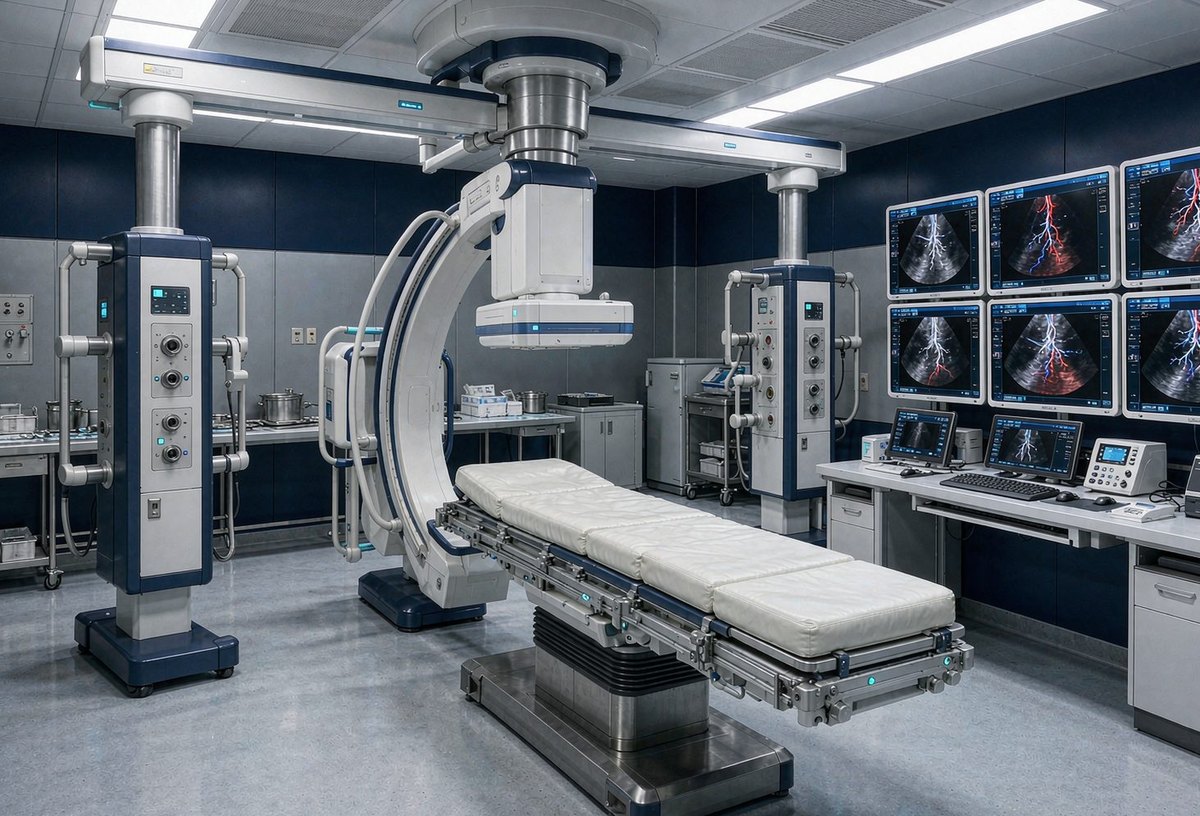
Heart surgery at volumes Western centres rarely see.
Bypass and valve surgery at one-fifth to one-sixth of US cash prices, at centres whose ICUs have seen your complication before. The constraint is not capacity; it is fitness to fly and rehabilitation afterwards.
China's leading cardiac centres perform more bypass and valve operations annually than almost anywhere else in the world, at roughly one-fifth to one-sixth of US cash prices. The constraint is not surgical capacity — it is fitness to fly, pre-operative optimisation and the quality of cardiac rehabilitation afterwards.
What China does differently
Surgical volume
Fuwai Hospital in Beijing performs more than 14,000 cardiac operations a year — among the highest of any centre worldwide. Zhongshan in Shanghai and Guangdong Provincial run comparably large programmes. Volume matters most when something goes wrong: an ICU that has managed your complication fifty times manages it better than one that has managed it twice.
Cost structure, not cost cutting
A bypass at $15,000–26,000 against $120,000 or more in the United States — the gap comes from labour and overhead, not from cheaper stents or reused equipment. Device choice still moves the quote by thousands, so ask which valve, conduit or stent is included and compare like with like.
Cardiac rehabilitation is the weak link
Structured rehabilitation after discharge is less developed than in Western systems, and you will probably return home before it is complete. We build the handover plan with your cardiologist at home before you travel — medications, target activity levels and the first follow-up tests with dates.
Where to go
- Fuwai Hospital, CAMS, Beijing — the highest volume; complex bypass, valve and aortic work
- Zhongshan Hospital, Fudan, Shanghai — structural heart and minimally invasive valve surgery
- Ruijin Hospital, Shanghai — complex coronary and hybrid procedures; JCI-accredited
- Guangdong Provincial People's Hospital, Guangzhou — a very large adult cardiac programme at lower cost
We are independent. No hospital pays for inclusion, and none of these entries implies a partnership or endorsement. International-department availability changes; we confirm it case by case.
What it costs
| Item | Planning range (USD) | Typical inpatient stay |
|---|---|---|
| Coronary bypass (CABG) | $15,000–26,000 | 18 nights |
| Heart valve replacement | $18,000–30,000 | 18 nights |
| Coronary stent (per stent) | $4,500–9,000 | 7 nights |
Planning ranges for public tertiary international departments, Beijing/Shanghai baseline. Device choice — valve type, conduit, stent manufacturer — moves the quote by thousands. Not quotations.
Timeline
Three to five weeks. The pre-operative workup takes three to five days and may change the plan. Expect seven to ten inpatient days after bypass, with two to three in intensive care. Flying home is usually cleared two to three weeks after surgery, sometimes longer.
Who should not come
- Patients with unstable angina, recent myocardial infarction or decompensated heart failure. Stabilise first; travel later, if at all.
- Anyone who cannot tolerate a long-haul flight, physically or medically.
- Patients whose own cardiologist advises against travel. Get that opinion before you ask for ours.
- Anyone expecting a stent without a diagnostic angiogram. No responsible centre stents on a foreign report alone.
Questions to ask the surgeon
How many of this exact operation did you perform last year? What is your in-hospital mortality and stroke rate, and how does it compare with the national registry? Which conduit or valve will be used, and is it in the written quote? Who manages the ICU and what is the nurse-to-patient ratio? What is the plan if I need a pacemaker, dialysis or a return to the theatre?
A centre that cannot answer these questions in writing is not ready for an international cardiac patient.
The answers we would want.
Is heart surgery in China safe for foreigners?
At the major centres, outcomes for standard procedures are comparable with international benchmarks. The added risk for a foreign patient is not the surgery — it is communication and continuity. That is why we require an international department, interpretation at consent and a written handover to your cardiologist at home.
Can I fly immediately after bypass surgery?
No. Two to three weeks is typical, depending on recovery, lung function and wound healing. Flying earlier raises the risk of pulmonary complications and leaves no margin if something goes wrong mid-flight.
What about medication afterwards?
You will leave on antiplatelets, statins, beta-blockers and possibly anticoagulants. Get the regimen in English with generic names and doses, and have your home doctor confirm it before the dispensed supply runs out. We include the medication plan in the discharge handover.
Last reviewed November 2026 · CMT Editorial Team · This page is general information, not medical advice.

Is heart surgery in China the right call for you?
Send your records for a free review. You will get a written specialist opinion, a hospital match and an itemised cost estimate — or an honest no.